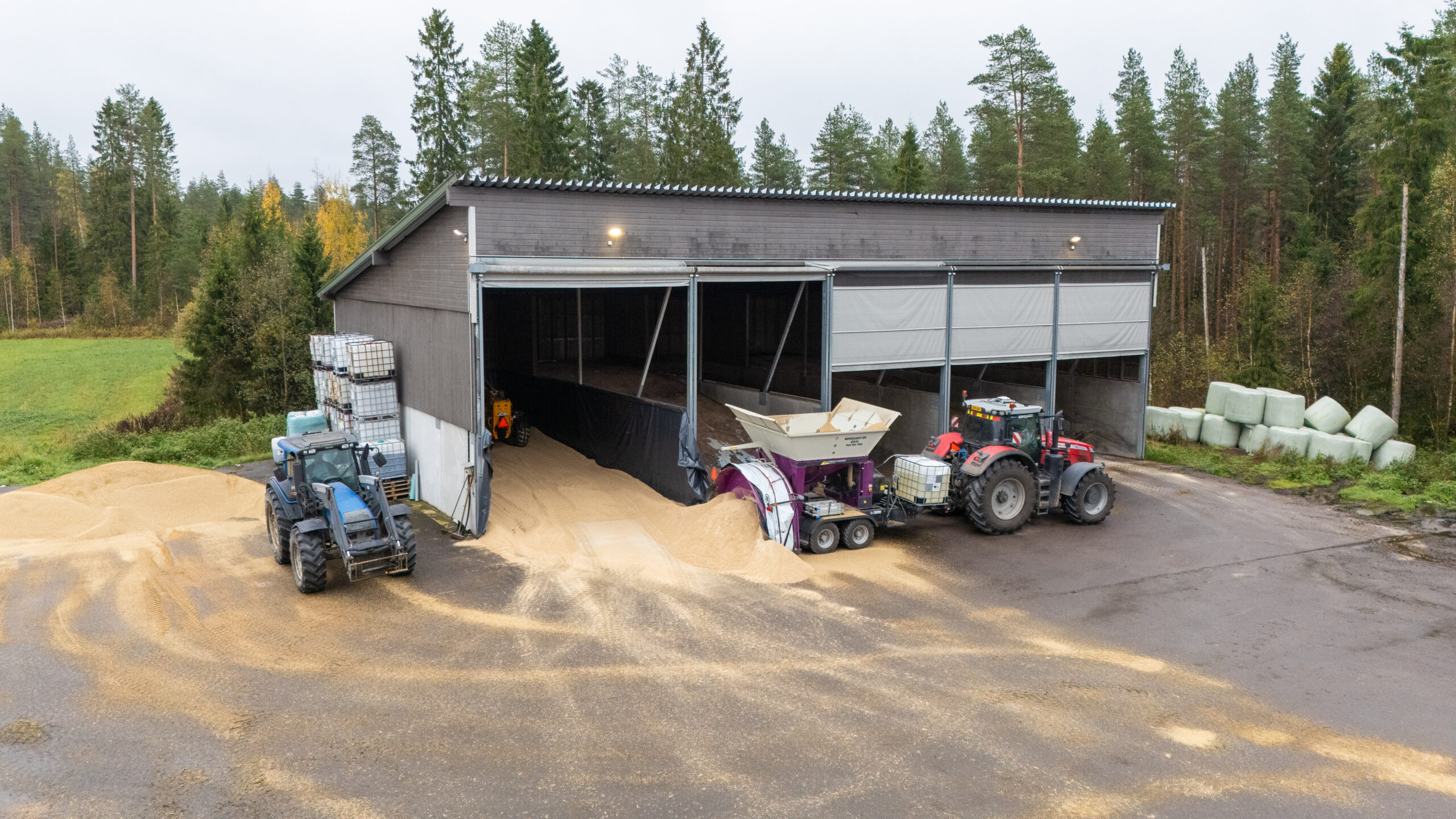
Hammer mills are essential pieces of agricultural equipment that transform whole grains into fine feed meal through high-speed impact grinding. Understanding how these powerful machines work is crucial for farmers and feed producers who want to optimize their grain-processing operations and achieve consistent feed quality.
The grinding process involves several key factors that determine the final product quality, from the mill’s mechanical design to grain moisture content. Let’s explore how hammer mills effectively convert dry grain into the fine feed meal that livestock operations depend on.
What is a hammer mill and how does it work?
A hammer mill is a high-speed impact grinding machine that uses rotating hammers to pulverize grain into smaller particles through repeated striking and shearing actions. The mill consists of a rotor with multiple hammers mounted on pins, enclosed in a grinding chamber with perforated screens that control particle size.
The grinding process begins when grain enters the mill’s grinding chamber through a feed hopper. As the rotor spins at speeds typically ranging from 1,800 to 3,600 RPM, the hammers strike the grain repeatedly, breaking it down through impact force. The hammers can be either fixed or swinging, with swinging hammers being more common because they can deflect when they hit foreign objects.
The ground material continues circulating within the chamber until particles become small enough to pass through the perforated screen. This screen acts as the final size-control mechanism, ensuring that only properly sized particles exit the mill. Airflow created by the rotor’s rotation helps move the ground material through the system and provides cooling during the grinding process.
How does the grinding process turn whole grain into feed meal?
The grinding process transforms whole grain into feed meal through a combination of impact, attrition, and shearing forces that progressively reduce particle size until the material reaches the desired fineness. Multiple impacts from the rotating hammers create fractures in the grain structure, while friction against the mill housing and screen further reduces particle size.
When whole grain enters the hammer mill, the high-speed hammers deliver initial impact blows that create the first cracks in the grain structure. These impacts occur with tremendous force due to the rotor’s rotational speed. The grain pieces then bounce around the grinding chamber, experiencing additional hammer strikes and collisions with the mill housing.
As the grain fragments become smaller, they experience more attrition and shearing forces. The material rubs against the screen surface and other particles, creating the fine meal texture. The process continues until particles are small enough to pass through the screen openings. Harder grains, such as corn, require more impacts to achieve the same fineness as softer grains, such as wheat or barley.
The entire grinding cycle typically takes only seconds, but each particle may experience dozens of impacts before reaching the proper size. This intensive mechanical action breaks down the grain’s cellular structure, making nutrients more accessible to livestock during digestion.
What determines the fineness of the final feed meal?
The fineness of feed meal is primarily determined by the screen size, hammer tip speed, and the number of hammers in the mill. Screen openings directly control the maximum particle size, while hammer configuration and rotor speed affect the grinding intensity and uniformity of the final product.
Screen selection is the most critical factor in determining meal fineness. Screens are available in various hole sizes, typically ranging from 1/16 inch to 1/2 inch in diameter. Smaller screen openings produce finer meal but require more energy and reduce throughput capacity. The screen’s open-area percentage also affects grinding efficiency, with higher percentages allowing better material flow.
Hammer tip speed, calculated from rotor diameter and RPM, significantly influences grinding effectiveness. Higher tip speeds create more impact force, producing finer particles but also generating more heat. Most hammer mills operate with tip speeds between 16,000 and 23,000 feet per minute for optimal grain-grinding performance.
The number and arrangement of hammers affect grinding uniformity and capacity. More hammers provide more impact points per revolution, creating more consistent particle size reduction. However, too many hammers can restrict airflow and create excessive heat buildup. The hammer-to-screen clearance also influences fineness, with closer clearances producing finer meal.
Why is proper grain moisture content important for hammer mill grinding?
Proper grain moisture content, typically between 10% and 14% for most grains, is crucial for efficient hammer mill operation because it affects grinding energy requirements, dust production, and final meal quality. Grain that is too wet creates paste-like conditions, while overly dry grain produces excessive dust and requires more energy to grind.
When grain moisture content is too high, usually above 16%, the material becomes tough and fibrous, making it difficult to grind effectively. Wet grain tends to stick to mill surfaces and screens, reducing throughput and creating uneven particle sizes. The material may also pack against the screen, preventing proper sizing and potentially causing the mill to plug.
Conversely, grain with moisture content below 10% becomes brittle and creates excessive dust during grinding. While this may seem beneficial for achieving fine particles, the dust creates handling problems, increases fire hazards, and can cause respiratory issues. Extremely dry grain also requires more energy to grind and may produce too many fine particles, affecting feed palatability and mixing characteristics.
Optimal moisture content allows the grain to fracture cleanly under hammer impact, producing uniform particle sizes with minimal dust generation. Properly conditioned grain flows smoothly through the mill, maintains consistent throughput, and produces feed meal with the desired texture and nutritional accessibility. We recommend testing grain moisture before grinding and adjusting mill settings accordingly to achieve optimal results.