Sheep farming success often comes down to the details of daily feed management. Grain is a cornerstone of many sheep rations, yet the way it is processed and stored has a far greater impact on animal performance than most producers initially expect. Whether the goal is faster lamb growth, better ewe condition heading into lambing, or simply stretching the feed budget further, understanding the relationship between sheep feeding, crushed grain, and grain preservation is a practical starting point for meaningful improvement on the farm.
This article walks through the key principles behind grain solutions for sheep farming, from why physical processing matters to how the right equipment choices support year-round feed efficiency. The aim is to give sheep producers a clear, evidence-based foundation for making better decisions at harvest, in the shed, and at the feed trough.
Why crushed grain outperforms whole grain for sheep
Sheep have a digestive system that is well adapted to fibrous forages, but whole grain presents a genuine challenge. Hard, intact kernels pass through the rumen and hindgut with limited breakdown, meaning a significant portion of the starch and energy content is never absorbed. Crushed grain removes this bottleneck by breaking the seed coat and exposing the starchy endosperm to rumen microbes, dramatically improving digestibility.
The practical result is straightforward: sheep extract more energy from each kilogram of feed when grain is processed before feeding. This translates directly into better body condition scores, improved daily weight gain in growing lambs, and stronger reproductive performance in ewes. In terms of raw feed efficiency, crushing grain is one of the simplest interventions a producer can make without changing the diet itself.
There is also a welfare dimension worth noting. Whole barley and wheat in particular can cause digestive discomfort and uneven rumen fermentation when sheep consume them rapidly. Crushed or flattened grain ferments more predictably, reducing the risk of acidosis episodes that can set back flock health and productivity.
How grain preservation extends feed quality year-round
Harvesting grain at its nutritional peak and then storing it without quality loss is one of the central challenges of sheep nutrition management. Traditional dry storage requires grain to be brought down to safe moisture levels before it can be held without spoilage, a process that consumes energy and time. Grain preservation through airtight storage of moist, crushed grain offers a practical alternative that locks in nutritional value from the moment of harvest.
The method works by creating anaerobic conditions inside the storage structure, whether that is a tower silo, a bunker, or a plastic tube. Without oxygen, aerobic spoilage organisms cannot thrive, and the grain remains stable for months. Research in this area consistently shows that preserved moist grain retains higher levels of digestible starch compared to grain that has been dried at high temperatures, which can damage protein and reduce palatability.
An important additional benefit is mycotoxin risk reduction. Grain that is sealed quickly after crushing has far less opportunity to develop mould compared to grain left in open storage over winter. For sheep producers, this matters because mycotoxins affect reproductive performance, immunity, and general flock health in ways that are often difficult to diagnose without specific testing. Reducing that risk through proper preservation is a straightforward protective measure.
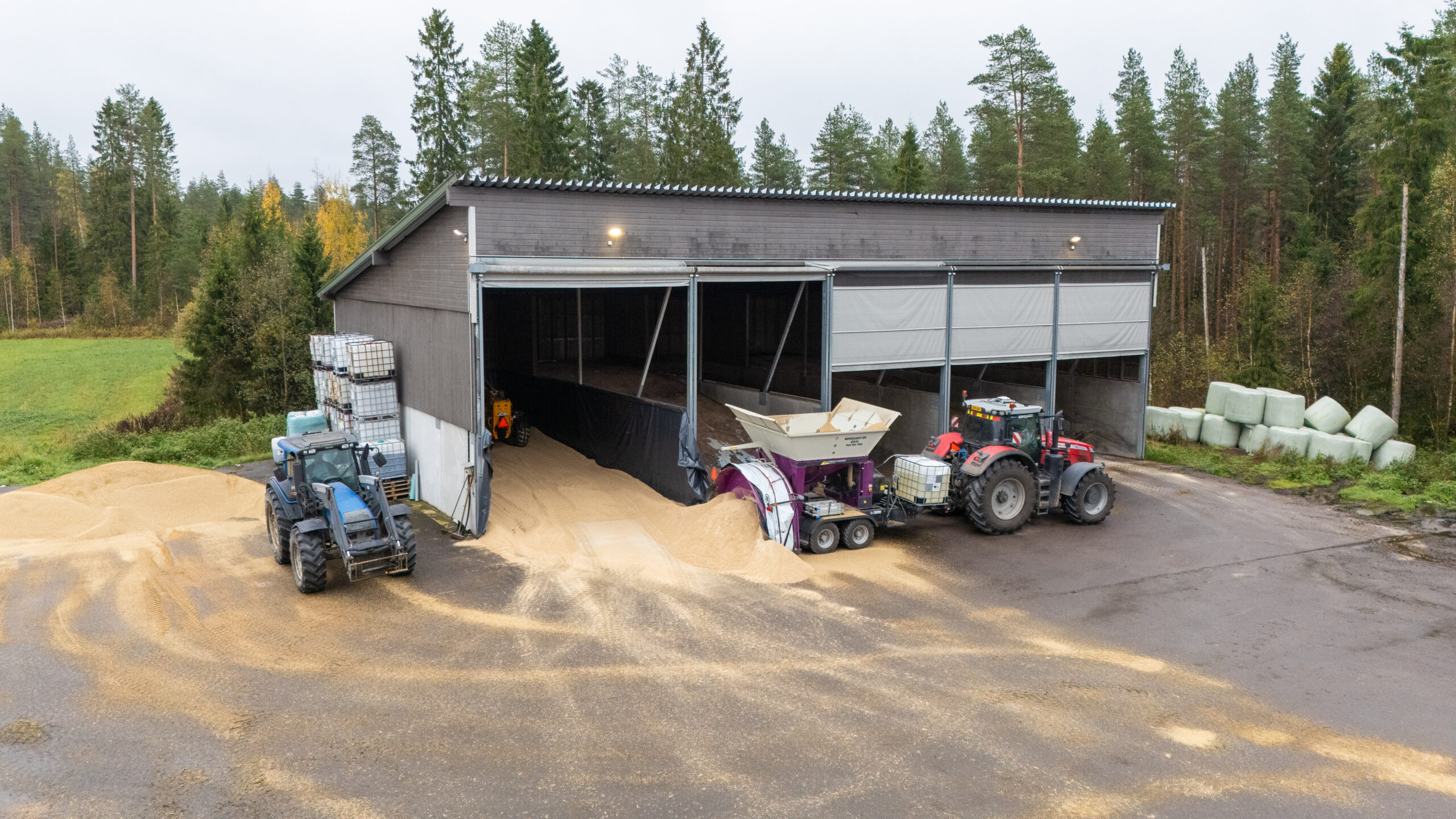
Tube storage in particular has grown in popularity because of its low capital cost and flexibility. Grain can be sealed directly from the crusher into a plastic tube, making the process fast and accessible even for smaller operations. This approach fits naturally with on-farm crushing workflows, keeping the entire process efficient from field to feeder.
Matching grain rations to sheep production stages
Sheep have significantly different energy and protein demands depending on where they are in the production cycle. A flat, one-size-fits-all ration approach almost always means underfeeding at critical times and overfeeding at others, both of which carry real economic costs. Matching crushed grain rations to specific production stages is a key part of getting the most from a preserved grain system.
Ewes through the reproductive cycle
Flushing ewes before mating with a rising plane of nutrition is a well-established technique for improving ovulation rates and conception. A modest increase in crushed grain supplementation during the three to four weeks before and after joining can meaningfully lift scanning percentages, particularly in ewes that are carrying body condition below the ideal range. The key is precision: too much grain too quickly can cause digestive upsets, so gradual introduction is essential.
In late pregnancy, the energy demands of carrying twins or triplets outpace what most pastures can supply, especially in late winter or early spring. Crushed barley or oats offered in small, regular amounts helps prevent pregnancy toxaemia, a metabolic condition that can be fatal in high-producing ewes. Preserved grain stored from the previous harvest makes this supplementation straightforward and cost-effective.
Lambs and growing stock
For lambs destined for market, the finishing period is where grain rations deliver the clearest return. Crushed grain fed to lambs from weaning through to slaughter weight supports faster daily gain and better carcase conformation compared to forage-only systems. Oats and barley are both suitable options, with barley offering higher energy density and oats providing a safer introduction grain due to its lower starch concentration.
Creep feeding lambs before weaning using finely crushed grain also accelerates rumen development, meaning lambs transition more smoothly onto post-weaning rations and experience less growth check at that vulnerable stage.
Choosing the right crushing and preservation equipment
The choice of grain processing equipment shapes everything downstream, from the texture of the finished feed to the speed of the operation and the long-term cost of ownership. Three main types of mill are used in sheep farming contexts, each with distinct characteristics suited to different situations.
A roller mill is the most common choice for farms producing moist crushed grain for silage-style preservation. It flattens the grain between two rollers, producing a consistent, flat flake that ferments evenly and is highly palatable to sheep. Roller mills handle wet grain efficiently and are well suited to high-throughput operations. We have built our roller mill range specifically for livestock farms producing moist grain feed, with robust construction designed to handle the demands of harvest season processing.
A disc mill uses grinding discs to produce a finer, more irregular particle size. This type suits farms where a finer grind is preferred, such as operations feeding intensively managed lambs or where grain is being incorporated into mixed rations. The disc mill handles both dry and moist grain and is particularly well suited to pig units or farms producing feed for multiple species.
A hammer mill grinds grain into a fine flour using rotating hammers. This suits situations where the feeding recipe specifically calls for dry, finely ground grain, such as certain cattle and pig nutrition programs. For sheep, hammer mills are less commonly the primary choice, but they can be useful where a very fine particle size is required for specific ration formulations.
When selecting equipment, capacity should be matched to the volume of grain processed at harvest and the frequency of feeding throughout the year. Oversized machinery carries unnecessary capital cost, while undersized equipment creates bottlenecks during the critical harvest window. Contact us to discuss which solution fits the scale and workflow of a specific operation.
Common mistakes in on-farm grain processing for sheep
Even well-intentioned grain processing programs can underdeliver if a few common errors are not avoided. Understanding where things typically go wrong helps producers get the full benefit from their investment in equipment and management time.
Processing grain too coarsely is one of the most frequent issues. A roller gap set too wide produces large, partially cracked kernels that offer only marginally better digestibility than whole grain. The target is a flat, fully opened kernel with no intact seed coats remaining. Regular checks on mill output and roller gap adjustment are a simple habit that pays dividends in feed conversion.
Delaying sealing after crushing undermines the preservation process. Moist crushed grain begins to heat and spoil within hours of processing if left exposed to air. The gap between crushing and sealing should be as short as possible, ideally measured in minutes rather than hours. Having storage structures prepared and ready before processing begins is basic but critical planning.
Introducing grain too rapidly to sheep that have not been on a grain diet is a reliable route to digestive problems. Rumen microbes need time to adapt to a high-starch diet, and sheep that gorge on grain after a period without it are at real risk of acidosis. A two-week introduction period with steadily increasing amounts is the standard approach and should never be skipped, regardless of production pressure.
Neglecting equipment maintenance during the off-season means problems surface at the worst possible time: the middle of harvest. Rollers wear over time and produce inconsistent results if not checked and replaced when needed. A pre-season service check on the mill, including inspection of rollers or discs, drive components, and any preservation additive dosing systems, is time well spent and avoids costly downtime when throughput demands are highest.
Getting grain processing right for a sheep enterprise is genuinely achievable with the right knowledge and equipment in place. The combination of properly crushed grain and effective preservation creates a feed system that supports animal performance across every stage of production, reduces input costs, and gives producers reliable access to quality feed regardless of what the season delivers.
Meet Murska at EuroTier 2026
Murska will be exhibiting at EuroTier 2026, one of the world’s leading trade fairs for professional animal production and livestock farming. The event takes place from 10 to 13 November 2026 in Hanover, Germany, and brings together producers, industry professionals, and technology providers from across the globe to explore the latest advances in animal nutrition, automation, animal welfare, and sustainable livestock production.
At the show, Murska will be presenting its range of solutions for efficient feed production, grain processing, and moist grain preservation. From roller mills to preservation systems, Murska’s products are designed to help farms improve production efficiency, reduce energy consumption, and optimise animal feeding programmes. EuroTier 2026’s focus on feeding technology, animal welfare, and sustainable production makes it an ideal setting to see Murska’s innovations in action.
We look forward to welcoming visitors to the Murska stand in Hanover. Come and meet our team, discuss your farm’s specific needs, and discover how the right grain processing solution can make a real difference to your operation.