Buying an electric grain mill is one of those farm decisions that looks straightforward on the surface but quickly reveals layers of nuance once you start digging into the numbers. The right mill at the right time can meaningfully cut feed costs, reduce tractor dependency, and give a farm tighter control over feed quality. But the timing matters just as much as the machine itself. This guide walks through the key signals, cost dynamics, and practical considerations that determine whether a grain mill investment makes sense for your operation right now.
Signs your farm is ready for an electric grain mill
A farm is typically ready for an electric grain mill when the cost and inconvenience of outsourcing grain processing start to outweigh the capital outlay of doing it in-house. If you are regularly paying a contractor to crush or roll grain, or driving loads to a commercial mill several times a season, the economics often shift in favour of ownership faster than expected.
Beyond the financial signals, there are operational ones too. If your tractor is already stretched thin during feeding time and you find yourself juggling PTO-driven equipment with other field tasks, an electric mill for the farm removes that bottleneck entirely. Electric drive means the mill runs independently, freeing the tractor for ploughing, spreading, or haulage. A livestock farm feeding daily, particularly one running dairy cattle or pigs, is almost always a strong candidate for electric grain processing equipment.
Grain storage on site is another prerequisite worth checking. If you are already storing your own cereal harvest or buying grain in bulk, you have the raw material ready to process on demand. That combination of on-farm storage and regular feed demand is the clearest sign that the step to an electric mill is a logical one.
How electric mills reduce long-term feed costs
The cost reduction from switching to an electric mill for the farm comes from several directions at once, and the cumulative effect over a full season is often larger than farmers initially expect.
The most direct saving is the elimination of contract milling fees and transport costs. When grain is processed on-site, the margin that would otherwise go to a third party stays on the farm. Electricity costs for running an electric mill are generally modest relative to those savings, especially when processing happens during off-peak hours or when the farm has a favourable energy tariff.
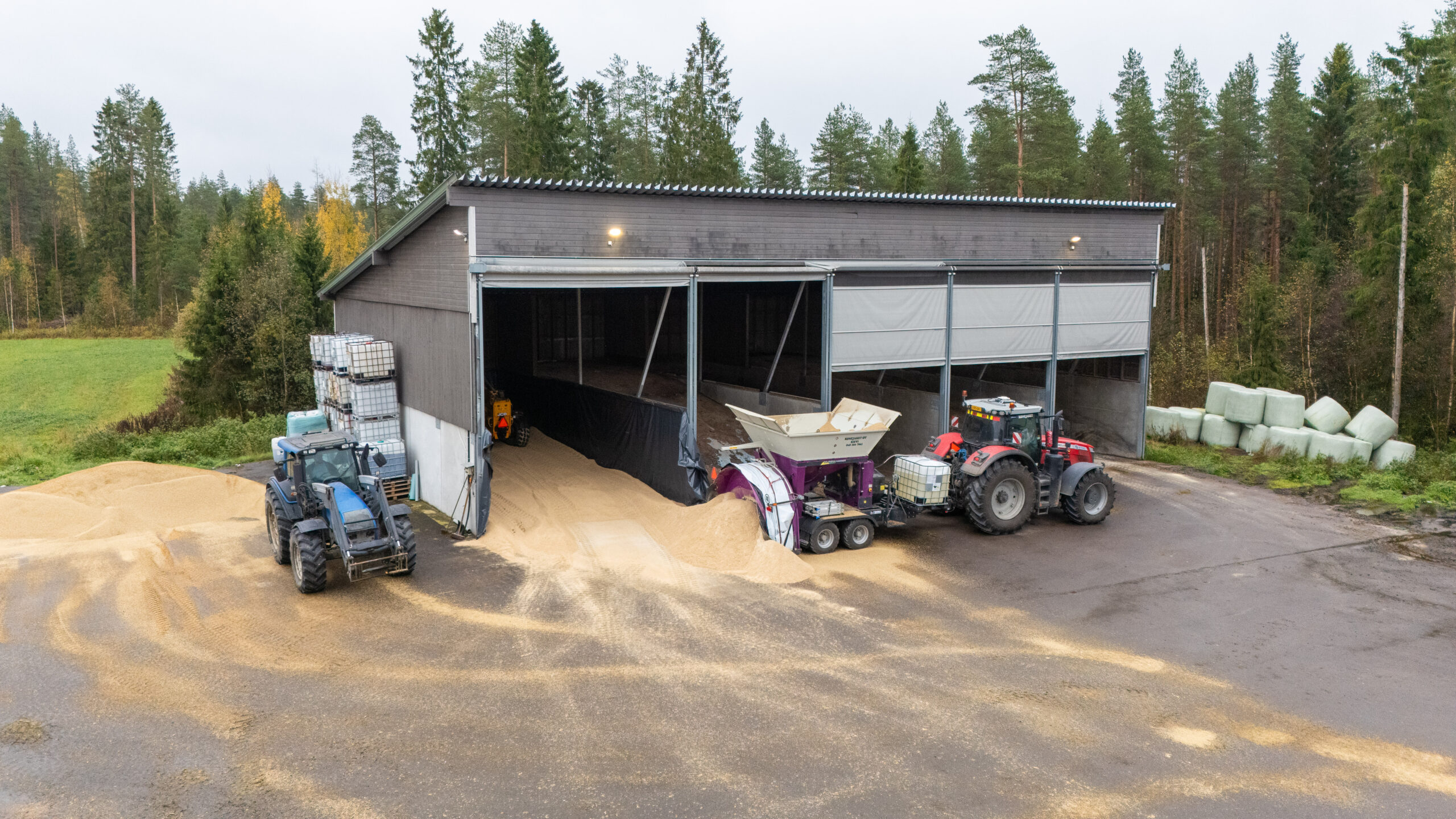
Feed quality plays a role in the economics too. Freshly processed grain retains more nutritional value than grain that has been milled, transported, and stored before use. Better feed conversion ratios mean less grain is needed to achieve the same animal performance, which compounds the cost savings over a full production cycle. For farms feeding propionic acid-treated grain, a roller mill like our Murska 220 SM handles both dry and treated grain efficiently, keeping the process flexible without additional equipment.
Matching mill capacity to your farm’s output
Choosing the right capacity is where many farms either over-invest or create a bottleneck that limits the mill’s usefulness. The goal is to match the mill’s hourly throughput to your realistic daily feed requirement, with a sensible margin for efficiency.
A small dairy or pig unit feeding a few hundred kilograms of grain per day will be well served by a compact roller mill with a capacity in the range of 600 to 1,500 kg per hour. For larger operations processing several tonnes daily, a higher-capacity machine becomes necessary. Our Murska 350 S2 with a 15 kW electric drive handles up to 10 tonnes per hour, while the Murska 700 HD and Murska 1000 HD scale up to 20 and 30 tonnes per hour respectively with 30 kW and 45 kW electric drives.
It is also worth thinking about the grain types you process. Farms mixing field beans, peas, or maize with cereal grain need a mill that can handle those harder materials without compromising throughput or wearing components prematurely. Actual capacity with legume mixes tends to be lower than the rated maximum for pure cereal, so build that into your planning when sizing the machine.
What affects the payback period of a grain mill
The payback period of grain processing equipment depends on a handful of variables that are specific to each farm, which is why two farms of similar size can have very different payback timelines.
The volume of grain processed annually is the biggest driver. A farm processing a large volume of grain each year recovers the capital cost much faster than one with modest throughput, simply because the per-tonne saving is applied more often. Related to this is the current cost of outsourced milling or bought-in compound feed. The higher that baseline cost, the faster the mill pays for itself.
Electrical infrastructure is another factor worth examining before purchase. A farm with sufficient electrical capacity and a suitable three-phase supply can install an electric mill with minimal additional cost. A farm that needs to upgrade its electrical connection faces a higher initial outlay, which extends the payback period. Maintenance costs and machine longevity also shape the long-term picture. A well-built, durable mill with low ongoing maintenance requirements will deliver a better return over its lifetime than a cheaper machine that needs frequent attention.
Common mistakes when choosing a farm grain mill
The most common error farms make when selecting a farm grain mill is choosing on price alone without fully accounting for the total cost of ownership. A lower purchase price can quickly be offset by higher energy consumption, more frequent wear-part replacement, or a capacity that does not quite meet daily demand, forcing the mill to run longer than intended.
Underestimating grain variety is another frequent mistake. A mill specified purely for dry barley or wheat may struggle with propionic acid-treated grain or legumes without the right roller configuration. It is worth discussing the full range of materials you expect to process before settling on a specification, rather than discovering the limitation after installation.
Farms also sometimes overlook the value of integrating the mill into a broader handling system. A mill that sits in isolation, requiring manual loading and unloading, adds labour that erodes the efficiency gains. Pairing a roller mill with screw conveyors that connect the grain store to the mill and then to the feeding system creates a smooth, low-labour workflow that multiplies the practical value of the investment. Thinking about the full material flow from storage to feed point, rather than just the mill itself, tends to produce much better outcomes.
If you are weighing up whether an electric grain mill is the right next step for your farm, we are happy to talk through the options based on your specific setup and requirements. Get in touch with us and we will help you find the right solution.