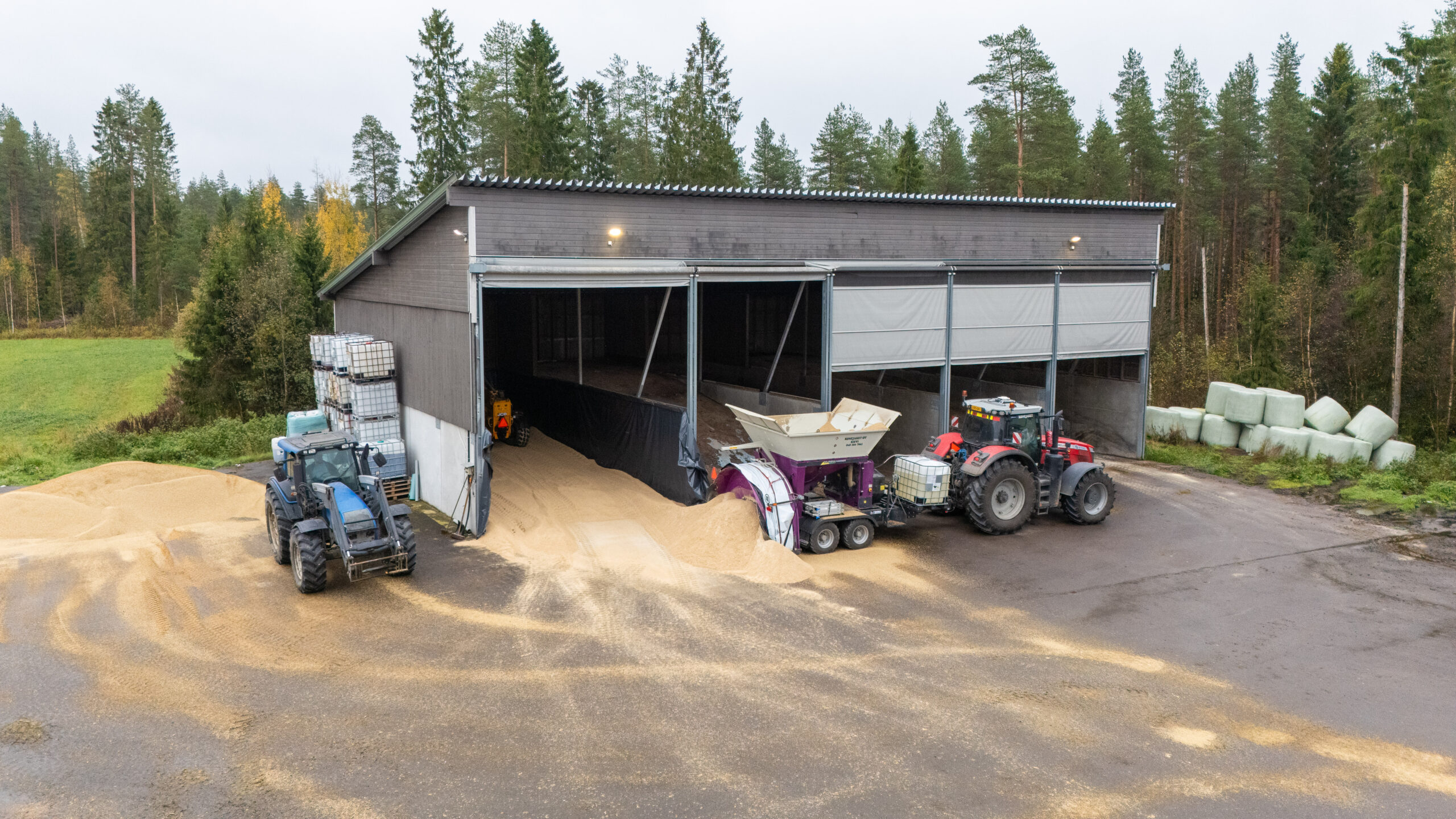
Grain processing is one of those farm costs that can quietly drain profitability when it goes unmeasured. Many farm operators have a rough sense of what their feed costs per tonne, but far fewer have a clear, itemized picture of what grain processing actually costs them across energy, equipment, labor, and quality outcomes. Building that picture is not complicated, but it does require looking at each cost driver in turn. Whether running a small operation with a compact roller mill or a larger setup processing tens of tonnes per hour, understanding your farm grain costs in detail is the foundation of smarter decision-making.
This guide walks through the key components of grain processing costs, how to measure them accurately, and where farms most commonly lose money without realizing it. By the end, the path toward a lower, more controlled cost per tonne should be much clearer.
Key cost components in grain processing
Calculating grain processing costs starts with identifying every input that contributes to the final cost per tonne. There are four primary categories: energy consumption, equipment ownership and maintenance, labor, and the indirect cost of feed quality outcomes.
Energy is typically the largest variable operating cost, especially for electric-powered mills. Equipment costs include depreciation on the mill itself, wear parts such as rollers or hammers, and routine servicing. Labor covers the time spent operating, monitoring, and cleaning the equipment. Feed quality, while not a direct input cost, affects the economic return on every tonne processed and therefore belongs in any honest cost calculation. Ignoring even one of these categories leads to an incomplete and misleading picture of true grain milling costs.
How to measure energy and equipment costs accurately
Energy consumption is straightforward to measure with a sub-meter or by reading the motor nameplate rating and tracking run hours. Multiply the motor’s rated kilowatt draw by the number of hours operated per year, then apply the farm’s electricity tariff. For example, a 15 kW roller mill running 400 hours per year at a typical agricultural electricity rate produces a concrete annual energy cost that can then be divided by total tonnes processed to give a cost per tonne figure.
Equipment costs require a slightly different approach. Take the purchase price of the mill, estimate its working life in years, and divide to get an annual depreciation figure. Add the average annual spend on wear parts and servicing. Farms often underestimate this figure because individual service visits feel small, but they accumulate significantly over a machine’s lifetime. Tracking every maintenance invoice in a simple spreadsheet over two or three seasons quickly reveals the true annual equipment cost, making future budgeting far more reliable.
Labor and time: the often-overlooked cost factor
Labor is the cost factor most frequently left out of farm cost calculations, yet it can represent a substantial share of total feed processing costs. Every hour spent loading, operating, cleaning, and troubleshooting the mill has a real economic value, whether the operator is a paid employee or the farm owner themselves.
A practical method is to log the total time spent on grain processing activities over a representative week or month, then multiply by a realistic hourly labor rate. For owner-operators, using the local agricultural wage rate as a proxy is a reasonable approach. Once labor is included in the cost-per-tonne calculation, the difference between a fast, high-capacity mill and a slower, lower-capacity machine often becomes much more significant than the purchase price alone would suggest. Reducing manual handling steps, for instance by integrating auger conveyors into the processing line, directly reduces the labor component of grain handling costs.
Feed quality and its effect on processing economics
Processing economics are not just about input costs. The quality of the processed feed directly affects how efficiently animals convert feed into production, which has a measurable impact on farm profitability. A mill that produces inconsistent particle size or damages the grain’s nutritional value can increase feed conversion ratios, meaning more feed is needed to achieve the same output from livestock.
Roller mills, for example, are generally recognized for producing a more uniform, gentle crush compared to hammer mills, which can over-process grain and increase fine particle content. Fines are less efficiently digested by many livestock species and can cause respiratory or digestive issues. When calculating the true economics of grain processing, factoring in even a modest improvement in feed conversion ratio can dwarf the savings from a cheaper mill or lower energy tariff. Feed quality is therefore not a soft consideration but a hard economic variable.
Common mistakes that inflate grain processing costs
Several recurring mistakes push farm grain costs higher than they need to be. The most common is running a mill that is either too large or too small for the actual throughput requirement. An oversized machine runs at low utilization, increasing cost per tonne through underused capacity and higher fixed costs. An undersized machine runs at maximum load continuously, accelerating wear and increasing downtime.
Other frequent mistakes include:
- Neglecting roller or hammer maintenance until performance drops, which increases energy draw and reduces output quality
- Processing grain at the wrong moisture content, leading to poor crush quality and higher energy consumption
- Failing to track actual throughput, which makes it impossible to know the true cost per tonne
- Overlooking the cost of tractor-powered processing, where the full cost of tractor time, fuel, and wear is rarely attributed to the milling operation
Switching to electric-powered milling, where the electrical supply allows it, removes tractor dependency and makes energy costs far easier to measure and control.
Choosing the right mill to optimize your cost per tonne
Selecting the right mill is ultimately a matching exercise between the farm’s daily feed requirement, the grain types being processed, the available power supply, and the target cost per tonne. A mill that is well matched to its application will consistently outperform a technically superior machine that is poorly suited to the task.
For smaller daily requirements, a compact electric roller mill such as the Murska 220 SM offers an efficient and practical solution, with a crushing capacity of 600 to 1,500 kg per hour and a modest 4 kW power requirement. For larger operations, electric-drive options on higher-capacity roller mills scale the same logic upward, with models available with 15 kW through to 45 kW drives covering throughputs up to 30 tonnes per hour under suitable conditions. In each case, the key calculation remains the same: total annual cost divided by total tonnes processed, benchmarked against the feed quality outcome the mill delivers.
Taking the time to run this calculation properly, including energy, equipment, labor, and feed quality, gives a clear and honest view of where processing costs sit today and where they could realistically be reduced. If you would like to discuss which milling solution fits your operation’s specific requirements, get in touch with us and we will be happy to help you work through the numbers.